


For many Colorado homeowners, the electric bill is no longer just about how much energy the home uses. It is also about when the home uses it.
Many utilities charge higher rates for electricity during peak-demand periods, which often line up with normal evening routines like cooking, laundry, heating or cooling, charging devices, and settling in after work or school. For many households, the peak-rate window is not some optional period of wasteful energy use. It is when people come home, cook, cool or heat the house, charge devices, and move through their evening routine.
Solar can reduce the amount of electricity a home buys from the grid. But under time-of-use pricing, solar-only systems can still leave homeowners exposed to expensive evening electricity. Storage changes that equation, becoming most valuable when it is planned around the home’s real energy habits, future upgrades, and backup needs.
What are time-of-use rates?
Time-of-use (TOU) rates charge different electricity prices depending on the time of day. Under Xcel Energy’s residential time-of-use structure in Colorado, weekday electricity is more expensive during the evening on-peak period and less expensive during off-peak hours.
The utility logic is straightforward: when many homes use electricity at the same time, the grid is under more stress and power can be more expensive to deliver. TOU pricing encourages customers to shift usage away from those high-demand hours.
But this is not neutral for residents.
TOU pricing rewards households that can easily move energy use around. It is harder on people whose lives are less flexible: families cooking dinner after work, people with medical equipment, older homes with poor insulation, households with older appliances, or households that cannot delay heating, cooling, laundry, or EV charging until later at night.
In other words, TOU pricing can help the utility manage peak demand, but it also asks homeowners to reorganize daily life around utility price signals. That may reduce grid stress, but it does not necessarily give residents more control.
A better long-term question is not just, “How do I avoid using electricity when Xcel says it is expensive?”
It is:
How do I produce, store, and manage my own energy so my home is less exposed to future rate changes?
Why the evening window matters for solar homes
Solar panels are most productive when the sun is highest, but household demand often climbs later in the day. That timing gap is one of the biggest reasons solar design should be evaluated alongside storage, utility rates, and the home’s actual usage pattern. A solar-only system can produce a large amount of electricity over the course of a year and still leave the home dependent on the grid during expensive evening hours.
This creates a simple question: If your solar panels produce during the day, but your home uses expensive electricity in the evening, where does that evening power come from?
During the middle of the day, a solar-only system may produce more electricity than the home can use at that moment. That extra power can be sent back to the grid and credited through the utility’s solar credit or net metering structure. Later, when solar output drops and evening demand picks up, the home may still need to buy electricity from the grid, often during a more expensive peak-rate window.
That does not make solar-only a bad investment. It means solar production and household consumption do not always line up on their own. A system can be sized to match a home’s annual electricity use, but without storage, the home may still rely on the grid during evenings, cloudy periods, winter storms, or future high-load periods.
The financial value of solar depends not just on how much electricity the system produces over a year, but when it produces, when the home uses energy, and how exported power is credited by the utility. Storage helps protect the value of a solar investment by keeping more of that daytime production available for the home’s evening needs, which is why the next question is not just whether solar makes sense, but what battery storage really changes.
What a battery changes
A home battery can help in three main ways:
- Store extra solar power during the day instead of sending all excess production back to the grid.
- Discharge stored power during the evening peak window when grid electricity is more expensive.
- Provide backup power to selected circuits during an outage
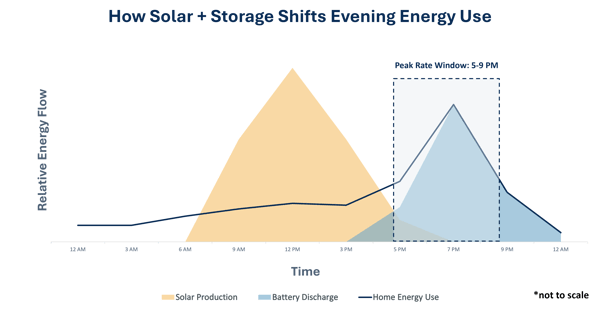
How solar production, household energy use, and battery storage can interact under time-of-use rates. Solar production often peaks before evening household demand, while battery storage can help shift daytime solar energy into higher-cost hours.
But installing a battery is not the whole strategy. A good energy plan connects three parts of the home:
Energy use: Current electric usage, evening load patterns, and the household’s utility rate structure.
Home performance and readiness: Insulation, air sealing, window performance, electrical panel capacity, existing heating and cooling equipment, and any older wiring or appliance limitations.
Future energy needs: Solar production potential, backup power goals, battery options, and future loads such as heat pumps, EV charging, or induction cooking.
A true energy expert sees the home as a system - considering how energy is produced, stored, used, and lost, all while ensuring today’s upgrades can support tomorrow’s needs.
Should you switch to solar and storage just because of time-of-use rates?
Yes, time-of-use rates are a good reason to consider solar plus storage. But the better question is whether the system supports your broader financial, energy, and environmental goals.
An Energy Expert can help turn your bill history, evening usage, roof potential, backup needs, and future electrification plans into a practical home energy plan. A well-designed system should help reduce exposure to peak pricing while also preparing your home for future loads, improving resilience, and lowering reliance on fossil-fuel-powered grid electricity.
A good energy plan should consider:
Usage: When does your home use the most electricity, and how much of that use happens during higher-cost hours?
Purpose: Are you trying to reduce peak-rate exposure, improve outage resilience, use more of your own solar power, or prepare for future electric loads?
Fit: Does your home’s roof, electrical panel, existing equipment, and future upgrade plan support the system being recommended?
Colorado’s grid is also changing quickly. Xcel’s approved Colorado Clean Energy Plan includes approximately 6,100 megawatts of new generation and $12 - $13 billion in investment across the state.
For homeowners, the takeaway is simple: electricity planning is becoming more complex with new generation, transmission, electrification, and reliability needs all shaping future utility planning.
The key is not just installing the right equipment. The key is designing a system around how your home actually uses electricity. Rate structures, incentives, export credits, and peak pricing can all change over the life of a solar or battery system, so a good consultation should not only ask what your bill looks like today, but what it might look like over the next 5, 10, or 20 years.
Resources & Further Reading
Xcel Energy: Time-of-Use Pricing
For current details on Xcel Energy’s residential time-of-use rate structure in Colorado.
Xcel Energy: Colorado Clean Energy Plan
For Colorado-specific context on Xcel’s planned investments in new generation, transmission, and long-term grid planning.
Private vs. public value of U.S. residential battery storage operated for solar self-consumption | Berkely Lab
Research on how home batteries can help households use more of their own solar power instead of sending excess production back to the grid.
Backup power or bill savings? How electricity tariffs impact residential solar-plus-storage usage in the United States | Berkely Lab
Research on why battery settings matter, especially when homeowners want both daily bill savings and backup power during outages.

Ready to plan around your home’s actual energy use?

Comments